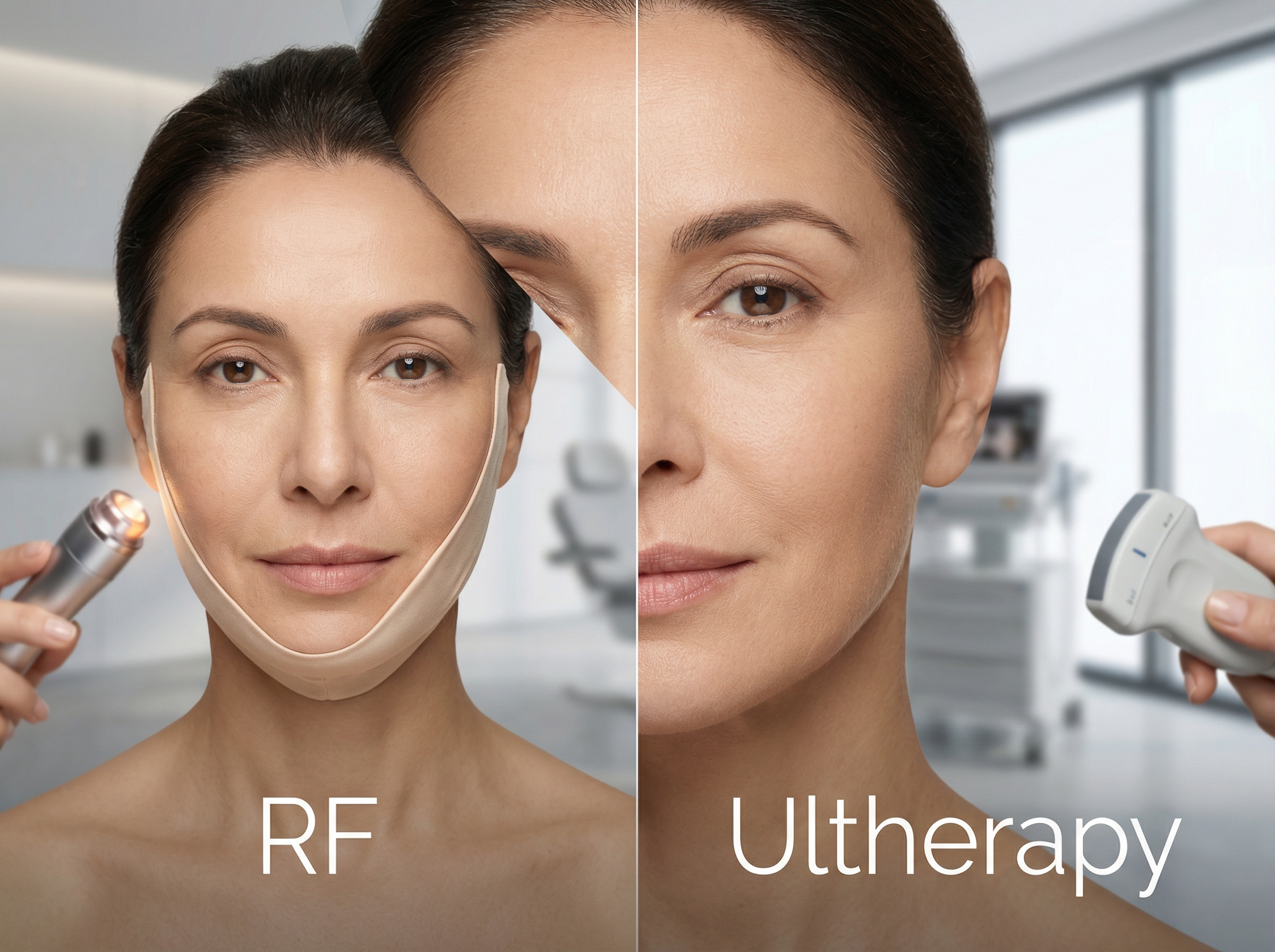
Jowls form as skin laxity, fat descent and collagen loss change lower-face contours. This article compares radiofrequency (RF) treatments and Ultherapy (microfocused ultrasound) for jowl tightening within the broader context of non‑invasive rejuvenation options. Learn mechanisms, expected results, downtime, safety, patient selection and when combination approaches or surgical referral are the best choice.
Why jowls happen and how to assess them
Understanding what is actually happening beneath the surface is the only way to choose between Radiofrequency (RF) and Ultherapy. Jowls are not just “loose skin.” They are the result of a complex structural collapse involving bone, ligaments, fat, and the dermis itself. If you treat the skin but ignore the sliding fat pads or the shrinking jawbone, the results will always be underwhelming.
The Biological Cascade: Why the Lower Face Drops
The formation of jowls is rarely due to a single factor. It is a synchronized decline of four distinct anatomical layers. By the time you notice a break in your jawline in the mirror, usually in your late 30s or 40s, these processes have been active for years.
Bone Resorption and Structural Loss
The skeleton is the scaffolding of the face. As we age, the mandible (jawbone) actually shrinks. Research updated through 2025 indicates that the mandible loses volume and rotates backward over time. Women are particularly susceptible, losing up to 25% of mandibular volume by age 60, compared to about 17% in men. When this bone recedes, the soft tissues sitting on top of it lose their support and slide forward and down. This is why jowls often appear worse in patients with naturally weak chins.
Ligament Attenuation
Your face has retaining ligaments that act like “tree trunks,” anchoring the skin and soft tissue to the bone. The zygomatic and mandibular ligaments are the primary support for the mid and lower face. Over time, these ligaments stretch and weaken—a process called attenuation. They lose their ability to hold the soft tissue in place. When the mandibular ligament weakens, it can no longer tether the skin along the jawline, allowing the tissue to bulge over the edge.
Facial Fat Descent and Hypertrophy
Fat redistribution is tricky. We lose volume in the cheeks (deep fat pads), which causes the skin to drape lower. However, the superficial fat pads in the lower face often remain or even grow slightly. Gravity pulls this fat downward. Because the mandibular ligament eventually halts this slide, the fat pools right above it, creating the characteristic “pouch” of the jowl.
Dermal Thinning and Elastin Loss
Finally, there is the skin itself. Collagen production drops by about 1-2% every year after age 30. More critically for jowls, we lose elastin—the protein responsible for the skin’s “snap back” quality. Elastin production decreases significantly starting in our 20s. Without elastin, the skin cannot resist the weight of the descending fat pads.
Clinical Assessment: Beyond the Mirror
When you visit a clinic in 2025, the provider should not just look at your face; they need to touch it. A proper assessment determines whether you need surface tightening (RF), deep structural lifting (Ultherapy), or a surgical referral.
Visual Inspection and Animation
The clinician will observe your face at rest and while animated. They look for asymmetry, as jowls often develop unevenly depending on sleeping positions and dental structure. They will check for the “pre-jowl sulcus,” which is the hollow area right in front of the jowl that accentuates the sagging.
Palpation and Tissue Mobility
This is the most critical step. The provider will pinch the tissue to assess thickness and mobility.
- The Pinch Test: If the tissue is thin and crinkles easily (crepey), the issue is largely dermal laxity. This often points toward RF treatments.
- Volume Assessment: If the area feels heavy, thick, or full, the problem is likely descended fat. Top Treatments for Sagging Skin in 2025 suggest that heavy tissues generally require the deeper penetration of ultrasound (Ultherapy) to lift the SMAS layer, rather than just tightening the surface.
- Bone Support: The provider will feel the jawline to see how much skeletal support remains.
Standardized Photography
You cannot rely on selfies to track progress. Clinical photography requires consistent lighting and specific angles. The standard protocol includes a frontal view, a 45-degree oblique view (the best angle to see jowls), and a 90-degree profile view. In 2025, many clinics use 3D imaging systems to quantify volume changes, but standard high-resolution photography remains the baseline.
Grading Severity and Skin Quality
To choose the right device, clinicians grade the severity of the jowl. This manages expectations, as non-invasive devices have ceilings on what they can achieve.
The Merz Scale for Jowls
This is a widely used 5-point scale (0-4) to standardize diagnosis:
- Grade 0: No sagging. Continuous jawline.
- Grade 1 (Mild): Minimal overhang. The jawline is slightly interrupted.
- Grade 2 (Moderate): Visible fold of skin and fat. The jawline is clearly broken.
- Grade 3 (Severe): Significant descent of tissue extending below the jawline.
- Grade 4 (Very Severe): Extreme skin laxity and heavy fat descent.
Skin Thickness and Quality
The thickness of your dermis dictates how heat travels through it.
Thin Skin (< 2mm): Patients with thin skin often respond better to Radiofrequency. Their skin heats up quickly and uniformly. Ultherapy can sometimes be too aggressive for very thin skin if not customized carefully.
Thick/Sebaceous Skin (> 2mm): Thicker skin requires more energy to tighten. Microfocused ultrasound (Ultherapy) is often superior here because it bypasses the surface and delivers high heat directly to the deep fascia (SMAS), which is strong enough to pull the heavy skin back.
Setting Realistic Goals and Identifying Red Flags
The biggest source of dissatisfaction in aesthetic medicine is a mismatch between patient expectation and technological reality.
What Non-Invasive Can Do
It is vital to understand that energy-based devices do not remove skin. They shrink it. A realistic outcome for a successful RF or Ultherapy treatment is a 20-30% improvement in tightness. This translates to a sharper contour and a reduction in the “shadow” of the jowl, but not a completely straight jawline if the laxity was moderate to begin with.
Red Flags for Non-Surgical Treatment
There are specific anatomical signs that indicate a patient is not a candidate for RF or Ultherapy and should be referred for surgery (facelift or neck lift).
- Platysma Banding: If you have prominent vertical cords in your neck that are detached from the underlying muscle, energy devices will not fix them.
- Excessive Fat: If the jowl is primarily a large pocket of fat, heating it may not be enough. Liposuction or surgical removal might be necessary before tightening.
- Severe Laxity (> 3cm descent): If the skin hangs significantly below the jawline (Grade 3-4), non-invasive devices cannot contract the skin enough to take up that much slack.
- Massive Weight Loss: Skin that has been stretched by significant weight gain and then lost its volume often has broken elastin fibers. It responds poorly to heat stimulation.
Assessment Summary Table
This table outlines how different clinical findings steer the treatment plan between RF and Ultherapy.
| Clinical Feature | Assessment Method | Indication for RF | Indication for Ultherapy |
|---|---|---|---|
| Skin Thickness | Calipers / Pinch Test | Thin to Medium | Medium to Thick |
| Primary Issue | Visual / Palpation | Surface Laxity / Crepiness | Deep Structural Droop |
| Fat Volume | Palpation | Low Volume (Skin only) | Moderate Volume (Heavy) |
| Severity Grade | Merz Scale | Grade 1 (Mild) | Grade 2 (Moderate) |
| Pain Tolerance | Patient History | Lower Tolerance | Higher Tolerance |
If you fall into the “Mild to Moderate” category with realistic expectations of a 20-30% improvement, you are the ideal candidate for these technologies. If your assessment reveals heavy fat pads or severe bone loss, your provider might suggest combining these treatments with fillers to restore structural support before tightening the skin. RF vs. Ultrasound: Best Skin Tightening Method in 2025 highlights that understanding your specific tissue type is the single most important factor in this decision.
Once the assessment is complete and you have determined that your anatomy is suitable for energy-based tightening, the next step is understanding exactly how Radiofrequency interacts with your tissues to reverse these signs of aging.
How RF works and practical considerations
Radiofrequency (RF) technology has shifted from a novel aesthetic concept to a cornerstone of non-surgical lower face rejuvenation. While the previous section outlined the anatomical decline that leads to jowls—specifically the loss of collagen and the attenuation of mandibular ligaments—RF addresses these issues by leveraging electrical energy to force a biological “reset” within the dermis and subdermal layers.
The Mechanism of Action: Resistance and Heat
Unlike lasers, which rely on light absorption, radiofrequency works through electrical resistance. When RF energy passes through the skin, the tissue resists the flow of current. This resistance, known as impedance, generates heat. For effective jowl tightening, the goal is to raise the temperature of the target tissue to between 55°C and 65°C, while keeping the epidermis (the skin surface) cool and intact.
This thermal injury triggers a three-phase biological response:
- Immediate Contraction: When collagen fibers are heated to specific temperatures, the hydrogen bonds holding their triple-helix structure together break. This causes the fibers to unwind and shorten immediately, often resulting in a visible “shrink-wrap” effect right after the procedure.
- Heat Shock Protein Activation: Within 24 hours, the thermal stress activates Heat Shock Proteins (specifically HSP70). These proteins signal the body that injury has occurred, initiating a wound-healing cascade.
- Neocollagenesis: Over the subsequent weeks and months, fibroblasts (the cells that build connective tissue) produce new, thicker collagen and elastin. Studies indicate that neocollagenesis peaks around 3 months post-treatment, with tissue thickness increasing by 20-40%.
Variants of RF Technology
Not all RF devices treat jowls the same way. The configuration of the electrodes determines how deep the energy travels and how focused the heat becomes.
Monopolar RF
This is the deepest penetrating form of pure RF. A single electrode is applied to the face, while a grounding pad is placed on the patient’s back. The current travels through the body to the grounding pad, allowing heat to penetrate 20mm to 50mm deep. This bulk heating affects the entire dermal and subdermal architecture, making it highly effective for patients with thicker tissue or significant volume in the jowl area. It creates a uniform column of heat that tightens septae (fibrous bands) in the subcutaneous fat.
Bipolar and Multipolar RF
Bipolar devices use two electrodes on the handpiece, meaning the current only travels between them. This limits the depth of penetration to roughly 5-15mm. While less effective for deep structural lifting, it is exceptional for tightening superficial skin laxity and improving the “crepey” texture often seen overlying the jowl. Multipolar systems use complex algorithms to switch between multiple poles, creating a dense energy field that can target depths from 3mm to 20mm, often offering a more comfortable, albeit more gradual, treatment.
Microneedling RF (MNRF)
Devices like Morpheus8 or Profound RF combine physical remodeling with thermal energy. Insulated needles penetrate the skin to precise depths (typically 4mm to 8mm for the jawline) and release RF energy only at the tip. This bypasses the epidermis entirely, delivering high heat directly to the deep reticular dermis and subdermal fat. This method creates fractional coagulation zones, similar to aerating a lawn, which causes significant tightening and can even contour small amounts of fat in the jowl.
Treatment Protocols and Patient Experience
For standard non-invasive RF (monopolar/multipolar), a single session is rarely sufficient. The industry standard protocol for the lower face involves a package approach.
Session Frequency and Duration
A typical course consists of 3 to 6 sessions spaced 4 to 6 weeks apart. This spacing allows the inflammatory cascade to complete its cycle before the next stimulation. Sessions for the lower face and submental area usually last 45 to 60 minutes. In contrast, stronger Microneedling RF treatments are often performed in a series of 3 sessions spaced 4-6 weeks apart, or sometimes as a single aggressive treatment depending on the device and energy settings used.
Pain Management and Anesthesia
Comfort levels vary significantly by technology. Standard RF is generally well-tolerated, with patients reporting a “hot stone massage” sensation or intense warmth. Pain scores typically range from 3 to 5 out of 10. Anesthesia is often unnecessary, though some providers use a light topical numbing cream. Conversely, Microneedling RF is more painful due to the physical penetration of needles. For these procedures, a strong topical anesthetic (5% to 23% lidocaine/tetracaine mix) is applied 30-45 minutes prior, and some practices offer nitrous oxide (laughing gas) to manage discomfort.
Downtime and Side Effects
One of the primary appeals of RF is the minimal recovery time compared to surgical intervention.
- Standard RF: Often called a “lunchtime procedure,” most patients experience erythema (redness) and mild edema (swelling) that resolves within 24 to 48 hours. You can usually return to normal activities immediately.
- Microneedling RF: The downtime is more social than physical. Patients can expect visible grid marks, redness, and swelling for 2 to 5 days. Full “camera-ready” recovery may take 5 to 7 days.
Common side effects include temporary sensitivity and rare instances of burns or blisters if the handpiece loses contact with the skin. Post-care is straightforward: strict sun avoidance and the use of broad-spectrum SPF 50 are non-negotiable, as UV radiation degrades the new collagen being formed.
Efficacy and Realistic Outcomes
It is vital to manage expectations regarding “lifting.” RF does not surgically reposition the SMAS (Superficial Musculo-Aponeurotic System) like a facelift. Instead, it tightens the skin envelope.
Clinical data suggests that a full course of RF treatments yields a 25-35% improvement in skin tightness. Patient satisfaction scores for jowl tightening generally sit between 75% and 85% after a completed series. If you’re noticing Jawline softening, crepey skin, or mild laxity, RF skin tightening is typically the more effective, comfortable option compared to deeper ultrasound treatments, particularly for patients with thinner skin who need surface contraction rather than deep structural lifting.
Contraindications and Safety
While RF is safe for all Fitzpatrick skin types (I-VI) because it is “colorblind” (not targeting melanin), there are strict contraindications. Patients with pacemakers or internal defibrillators cannot undergo RF treatments due to electrical interference. Metal implants in the treatment area (like dental implants or plates in the jaw) can conduct heat and cause internal burns, although modern bipolar systems may be used with caution around these areas. Active infections, severe autoimmune disorders, and pregnancy are absolute contraindications.
Market Considerations: Cost and Provider Selection (2025)
As of late 2025, the cost of RF treatments in the United States varies by region and device brand.
| Treatment Type | Avg. Cost Per Session | Typical Package Cost | Maintenance |
|---|---|---|---|
| Standard RF (Monopolar/Multi) | $800 – $1,500 | $4,000 – $8,000 (6 sessions) | Every 6–12 months |
| Microneedling RF | $1,500 – $3,000 | $4,500 – $9,000 (3 sessions) | Every 12 months |
When selecting a provider, verify that the facility uses FDA-cleared devices. The skill of the operator is paramount, particularly with Microneedling RF, where depth settings must be adjusted based on the specific thickness of the patient’s skin over the mandible versus the cheek. Discover which skin rejuvenation device delivers the best results in 2025 by consulting with a board-certified dermatologist or plastic surgeon who offers multiple modalities, ensuring they recommend RF because it is right for your anatomy, not simply because it is the only machine they own.
While RF excels at tightening the skin envelope and improving texture, it has limitations in lifting heavy, descended soft tissue. For patients requiring deeper structural intervention, technologies that target the SMAS layer specifically may be more appropriate.
How Ultherapy works and practical considerations
While radiofrequency focuses on bulk heating the dermis to tighten skin texture, Ultherapy operates on a different physiological principle entirely. It is currently the only non-invasive procedure FDA-cleared specifically to *lift* the skin on the neck, under the chin, and on the brow. For treating jowls, this distinction between “tightening” and “lifting” is critical.
Understanding Microfocused Ultrasound with Visualization (MFU-V)
Ultherapy uses Microfocused Ultrasound with Visualization (MFU-V). Unlike lasers or RF that work from the outside in, this technology bypasses the surface of the skin to deliver energy at precise depths. The device focuses ultrasound waves to a specific focal point below the surface, similar to how a magnifying glass focuses sunlight to create heat.
The “Visualization” aspect is what separates Ultherapy from other ultrasound treatments like Sofwave or generic HIFU (High-Intensity Focused Ultrasound). The provider uses an ultrasound transducer to see the layers of tissue—skin, fat, and muscle—on a screen in real-time. This allows them to target the energy exactly where it is needed and avoid structures like bone or blood vessels.
The Mechanism of Action
The device delivers focused ultrasound energy to create Thermal Coagulation Points (TCPs). These are tiny zones of injury, roughly 1mm cubic in size, where the tissue is heated to between 65°C and 75°C. This temperature range is specific because it is the optimal point for denaturing collagen without causing uncontrolled burns. When the collagen fibers contract, they stimulate a wound-healing response. Over the following months, the body produces new, stronger collagen and elastin to heal these points, resulting in a lifting effect.
Target Depths for Jowls
For lower face and jowl treatment, providers typically use three distinct depths. The deepest setting, 4.5mm, targets the SMAS (Superficial Muscular Aponeurotic System). This is the same fibrous layer that plastic surgeons manipulate during a surgical facelift. Treating this layer provides the structural lift. The 3.0mm transducer targets the deep dermis to address structural integrity, and the 1.5mm transducer treats the superficial dermis to smooth skin texture.
The Treatment Protocol for Jowls
A standard protocol for the lower face and submental (under chin) area is rigorous. It is not a quick “lunchtime” facial in the same vein as a mild laser.
- Session Duration: A full lower face and neck treatment typically takes 60 to 90 minutes. With the introduction of Ultherapy Prime in early 2025, processing speeds have improved, potentially reducing chair time by about 20%, but the biological requirement for energy delivery remains the same.
- Line Count: The effectiveness of Ultherapy is dose-dependent. For the jowls and submental area, a provider will deliver between 300 and 600 lines of energy. “Skimping” on lines to lower the price often results in poor outcomes.
- Frequency: Unlike RF, which often requires a series of 3 to 6 treatments, Ultherapy is typically a single-session protocol. Touch-ups are usually performed every 12 to 18 months to maintain results as the aging process continues.
Pain Management and Comfort
We need to be honest about the sensation. Ultherapy is not painless. The energy is being delivered deep into the tissue, and when it hits the right depth, you will feel it. Patients describe the sensation as a deep, momentary prickling, heat, or a “zing” near the bone. Pain scores often range from 6 to 8 out of 10 during the pulses.
Pain Control Strategies
Topical numbing cream is standard but often insufficient on its own because the heat bypasses the skin surface where the cream sits. Most reputable practices in 2025 utilize Pro-Nox (a mix of nitrous oxide and oxygen) which you inhale during the painful parts of the treatment. Oral medications like ibuprofen or stronger prescribed anxiolytics are also common. If a provider tells you it feels like a “warm massage,” they are likely under-treating or using very low energy settings that may not yield results.
Recovery and Side Effects
One of the main reasons patients choose Ultherapy over surgery is the lack of downtime, but “no downtime” does not mean “no side effects.”
Immediate Aftermath
You can return to normal activities immediately. Your skin may appear flushed for an hour or two. Some patients experience mild swelling, particularly along the jawline, which can last for 3 to 5 days. This swelling can actually make the jowls look temporarily better immediately after treatment due to volume, but this subsides.
Delayed Effects
It is very common for the treated area to feel tender to the touch, similar to a bruise, for up to two weeks. You might also experience temporary numbness or tingling (paresthesia) in small areas, which resolves as the nerves recover. Bruising is rare but possible. If you experience facial muscle weakness or an asymmetric smile, seek medical evaluation immediately, as this indicates temporary nerve injury.
Timeline of Results
Patience is required. While some patients notice a temporary lifting effect immediately due to heat-induced collagen contraction and mild edema, the real results are biological.
- Month 1: The inflammation from the thermal coagulation points subsides. You likely won’t see major changes yet.
- Month 2-3: New collagen production (neocollagenesis) becomes visible. The jawline starts to look sharper, and the jowls feel firmer.
- Month 6: This is usually when peak results are observed. The skin structure is tighter and more lifted.
Ultherapy vs. RF: The Decision Framework
Choosing between Radiofrequency and Ultherapy depends largely on the anatomy of your jowls and the quality of your skin.
When to Choose Ultherapy
Ultherapy is the superior choice if your primary concern is gravity and structural descent. If you have moderate jowling where the tissue feels heavy and has dropped, you need the depth of the 4.5mm transducer to target the SMAS. It is also better for patients with thicker skin who might not respond as well to the surface heating of RF. Clinical studies, including a pivotal 2019 review, showed an 85% patient satisfaction rate for lifting sagging skin in the lower face.
When to Choose RF
If your jowls are caused more by loose, crepey skin rather than a heavy fat pad slipping down, RF might be better. RF tightens the “envelope” of the skin. For patients with very thin faces or significant volume loss, high-intensity ultrasound can sometimes be too aggressive, potentially leading to unwanted volume reduction if not visualized correctly. In these cases, the bulk heating of RF is often safer and provides a better aesthetic result.
Safety and FDA Clearance
Ultherapy has a robust safety profile backed by over a decade of clinical use. It received FDA clearance for a non-invasive brow lift in 2009, followed by clearances for lifting the neck and submental area (2012/2014) and improving lines on the décolletage. The visualization component is a key safety feature, allowing providers to avoid the marginal mandibular nerve, which, if hit, can cause temporary asymmetry in the smile. It is generally safe for Fitzpatrick skin types I-V, though caution is required for very dark skin (Type VI) to ensure the transducer is coupled correctly to avoid surface burns.
Patient Selection and 2025 Cost Considerations
The ideal candidate is between 35 and 65 years old with mild to moderate skin laxity. If you have severe jowling or significant platysmal banding (cords in the neck), non-invasive devices will likely not meet your expectations, and surgical options should be discussed.
Cost in the U.S. Market
As of late 2025, the cost for a lower face and neck Ultherapy treatment ranges from $4,000 to $6,000. While this is higher than a single RF session, remember that RF often requires a package of 3-6 treatments, bringing the total investment to a similar level ($4,500 – $9,000). Over time, ultrasound treatments may prove more cost-effective for the right candidate due to the longevity of the results.
Provider Qualifications
Because Ultherapy relies on interpreting ultrasound images, the skill of the provider is paramount. You should seek out a board-certified dermatologist, plastic surgeon, or a highly experienced physician assistant who has undergone advanced training specifically in MFU-V. This is not a treatment to shop for based on Groupon discounts, as poor technique can lead to nerve injury or fat atrophy.
Final recommendations and practical decision rules
We have reached the point where the science meets your schedule and your wallet. You now understand the mechanics of how Radiofrequency (RF) cooks the dermis to thicken it and how Ultherapy stitches the deeper SMAS layer with thermal coagulation points. But knowing the science does not automatically tell you which appointment to book.
Making the right choice for jowls often comes down to four specific variables: skin thickness, the severity of the sag, your pain threshold, and your patience for results. We can simplify this into a set of decision rules to guide your consultation.
The Decision Algorithm: RF or Ultherapy?
You should prioritize Radiofrequency (RF) if your primary issue is skin quality rather than heavy structural sagging.
This applies if you have thin or crepey skin that wrinkles easily when you pinch it. RF is generally safer for thinner faces because it provides bulk heating rather than focused deep energy, which carries a higher risk of nerve irritation in patients with very little subcutaneous fat. If you prefer a “slow and steady” approach with minimal discomfort (pain score 3-5/10) and zero downtime, RF is the logical path. It is also the go-to for maintenance in your late 30s to early 40s before significant jowling sets in.
You should prioritize Ultherapy if you have moderate heaviness and need a vertical lift.
This is for patients with thicker skin and palpable tissue descent who want a “one-and-done” annual treatment. If you can pinch more than a centimeter of tissue at the jawline but do not yet have a distinct fold of skin hanging over the mandible, the focused ultrasound depth of 4.5mm is necessary to target the SMAS layer. You must be willing to tolerate higher discomfort levels (pain score 6-8/10) during the procedure and wait 3 to 6 months for the full effect.
RF vs. Ultrasound: Best Skin Tightening Method in 2025 offers a good breakdown if you are still weighing the comfort levels, but generally, if you want to walk out and look normal immediately but see results later, Ultherapy fits the bill.
| Feature | Radiofrequency (RF) | Ultherapy |
|---|---|---|
| Best Candidate | Thin skin, surface wrinkles, mild laxity | Thick skin, heavy jowls, moderate laxity |
| Primary Goal | Texture improvement & skin thickening | Structural lifting & contouring |
| Pain Level | 3-5/10 (Warmth) | 6-8/10 (Deep prickling/heat) |
| Commitment | Series of 3-6 sessions | Single session (usually) |
| Results Timeline | Gradual over 2-3 months | Peaks at 6 months |
When to Combine or Stage Treatments
Monotherapy is rarely the answer for complex aging. By 2025, the standard of care has shifted toward combination protocols. We treat the skin in layers.
RF plus Microneedling (The Texture-Tightening Hybrid)
For jowls that have a “deflated” look with surface irregularities, standard RF might not be enough. Devices like Morpheus8 or Profound RF combine the two technologies. The needles physically break up old collagen while delivering RF energy directly into the dermis. This is the superior choice if you have acne scars or rough texture alongside mild jowling. Note that this increases downtime to roughly 2 to 5 days of social downtime compared to standard RF.
Ultherapy plus Fillers (The Lift-and-Fill)
Volume loss in the mid-face often exacerbates the appearance of jowls. As the cheeks deflate, skin slides down. A common 2025 protocol involves using Ultherapy first to tighten the structural envelope, followed by hyaluronic acid fillers or biostimulators (like Sculptra) to re-volumize.
Timing is critical: Do not inject fillers immediately before Ultherapy in the same area. The intense heat of the ultrasound (65-75°C) could theoretically degrade the filler or alter its properties. The general rule is to perform the tightening procedure first, wait 4 to 6 weeks for inflammation to subside, and then inject fillers.
When to Refer for Surgery
We must be honest about the limits of non-invasive tech. No machine can replicate the results of a scalpel. If you have Grade 3 or 4 jowling on the Merz scale, energy devices will likely leave you disappointed.
Red Flags for Non-Invasive Failure:
- Excessive Laxity: If the jowl hangs more than 3 centimeters below the jawline.
- Platysma Banding: If you see distinct vertical cords in your neck that do not resolve with Botox, energy devices cannot tighten this muscle effectively.
- Significant Fat: While Ultherapy can compact tissue slightly, it is not a fat reduction device. Heavy submental fat requires liposuction or Kybella before tightening.
If you fall into these categories, a consultation for a deep plane facelift or neck lift is the more financially prudent decision. Spending $5,000 on Ultherapy when you need surgery is an expensive mistake.
Safety Protocols and Care Checklists
Even non-invasive treatments carry risks. The high energy required to denature collagen means we are purposefully injuring the tissue to spark a healing response.
Pre-Treatment Checklist
- 7 Days Prior: Stop blood thinners (aspirin, fish oil, vitamin E) to minimize bruising, especially for Ultherapy or microneedling RF.
- Hydration: RF relies on water molecules to conduct heat. Drink 2-3 liters of water daily for 48 hours before your appointment to maximize efficacy.
- Pain Management: For Ultherapy, take 800mg of ibuprofen 45 minutes prior if your doctor approves. Many clinics now offer Pro-Nox (laughing gas) which is highly recommended.
Post-Treatment Care
- Cooling: You may use cool compresses for comfort, but avoid aggressive icing immediately after RF. We want the heat to stimulate the heat shock proteins (HSP70).
- Sun Protection: This is non-negotiable. Use SPF 50+ containing zinc oxide. Your skin is in a state of repair and is highly susceptible to UV damage.
- Swelling Watch: Mild edema is normal. If you experience asymmetry (one side of the mouth drooping) or severe pain after 24 hours, contact your provider immediately. This could indicate temporary nerve neuropraxia, a rare but known risk of deep ultrasound.
Cost-Effectiveness and Insurance Reality
Financial planning for these treatments is just as important as the clinical plan. In the US market for late 2025, the pricing models differ significantly. It is important to note that because treating jowls is considered a cosmetic procedure, insurance will not cover these costs.
RF is a “subscription model.” You pay less per visit—typically $800 to $2,500 depending on the device and location—but you must go frequently. A standard course is 3 to 6 sessions, bringing the total initial investment to roughly $4,500 to $9,000. Maintenance requires a touch-up session every 6 to 12 months.
Ultherapy is a “lump sum” investment. A full lower face and neck treatment averages $4,000 to $6,000. While the sticker shock is higher, you are paying for time saved. You typically only need to return every 18 months. Ultherapy Prime vs. Ultherapy | 2025 Technology Comparison highlights that the newer Prime systems are faster, potentially reducing chair time, though the price point remains premium.
The Verdict on Value
If you are younger (35-45) with mild laxity, RF is often more cost-effective because you may not need the full 6-session package to see results, and you can space maintenance further apart. For patients 50+ with moderate laxity, Ultherapy usually offers better ROI because achieving similar lift with RF would require an impractical number of visits.
To protect your investment, incorporate a medical-grade retinoid and daily antioxidant serum at home. These topicals support the neocollagenesis process initiated by the treatment. Think of the device as the workout and the skincare as the protein shake; you need both for the muscle—or in this case, the collagen—to build.
Ultimately, the “best” treatment is the one that aligns with your anatomy and your lifestyle. If you cannot tolerate pain, RF is the winner. If you cannot tolerate monthly appointments, Ultherapy takes the crown. Choose the method you can commit to, because consistency is the only magic wand we have.
References
- Ultherapy vs Sofwave: Key differences to consider in 2025 — While both are non-invasive procedures that use ultrasound, the difference between these treatments is how they stimulate your skin.
- RF vs. Ultrasound: Best Skin Tightening Method in 2025 — If you're noticing Jawline softening, crepey skin, or mild laxity, RF skin tightening is typically the more effective, comfortable option.
- RF vs. Ultrasound: Which Skin Tightening Treatment Wins? — Over time, ultrasound treatments may prove more cost-effective due to their longer-lasting results, which often persist for 12–18 months …
- Ultherapy Prime vs. Ultherapy | 2025 Technology Comparison — Immediate: Some patients notice slight tightening right after treatment · 2-3 months: Noticeable improvements become visible · 3-6 months: Peak …
- Ultherapy: The Best Skin Tightening Treatment of 2025 — Per a 2019 study, 85% of patients treated for sagging of the midface and lower face with Ultherapy were satisfied with their results.
- Most Effective Skin Tightening Treatments for Face and Neck — Discover the best non-surgical skin tightening treatments for the face and neck. Explore RF vs. laser skin tightening, ideal options for sagging
- Ultimate Guide to Skin Tightening: Comparing Top Technologies in … — Discover which skin rejuvenation device delivers the best results in 2025. Compare Morpheus8, Profound RF, NeoGen Plasma,
- Top Treatments for Sagging Skin in 2025: Your Guide — Defining the Jawline: Ultherapy is highly effective for tightening skin along the jaw and under the chin, reducing the appearance of jowls.
- Skin Tightening Treatments: Best of 2025 – Athena Plastic Surgery — Discover the best non-surgical skin tightening treatments for 2025. Restore youthful firmness with expert insights on RF, Ultherapy & more.
- The Truth About Ultherapy: Updated Treatment Review — Just launched in spring 2025 in the UK, Ultherapy Prime bills itself as a more advanced skin tightening and lifting treatment than 'normal' …
Legal Disclaimers & Brand Notices
The content provided in this article is for informational purposes only and does not constitute professional medical advice, diagnosis, or treatment. Always seek the advice of a qualified physician or other board-certified healthcare provider with any questions you may have regarding a medical condition or specific aesthetic procedure. Never disregard professional medical advice or delay in seeking it because of something you have read in this article.
All product names, logos, and brands mentioned in this text are the property of their respective owners. All company, product, and service names used in this website are for identification purposes only. Use of these names, logos, and brands does not imply endorsement. This includes, but is not limited to, the following trademarks:
- Botox® is a registered trademark of Allergan, Inc.
- Sculptra® is a registered trademark of Galderma Laboratories, L.P.
- Ultherapy® is a registered trademark of Merz North America, Inc.
The specific clinical outcomes, risks, and recovery timelines described are based on general medical literature and should not be interpreted as a guarantee of results. Individual patient experiences may vary significantly.