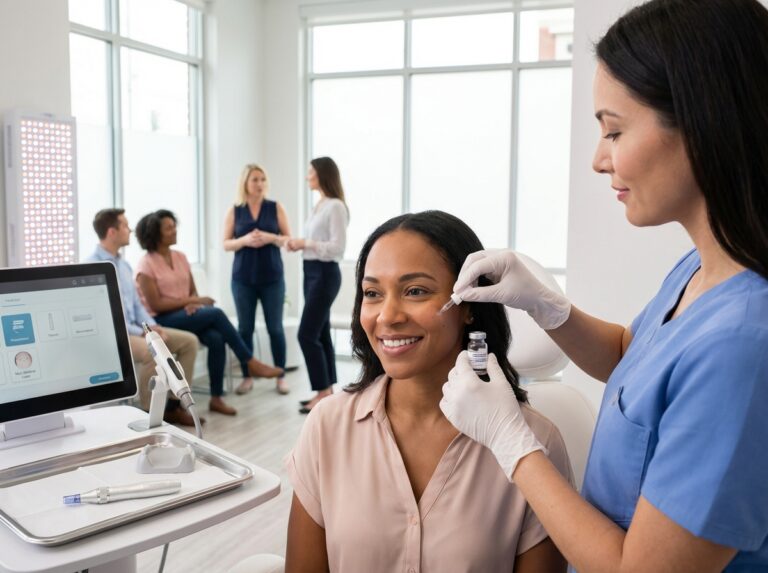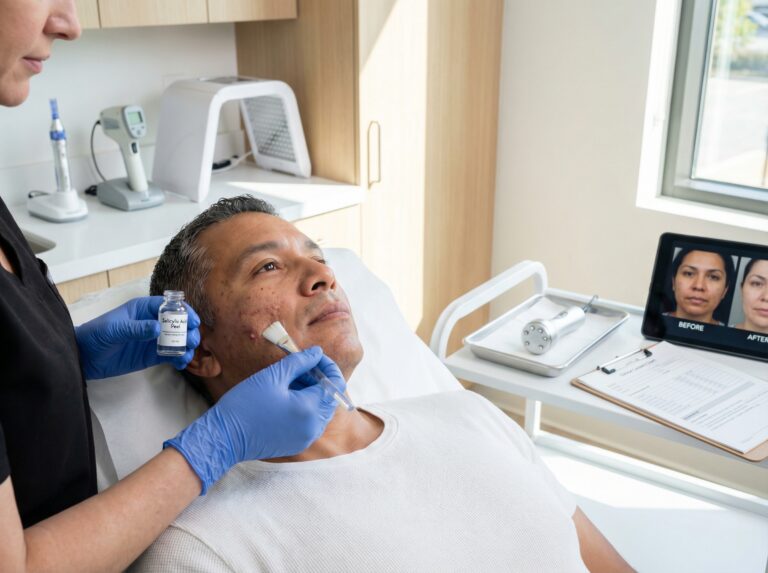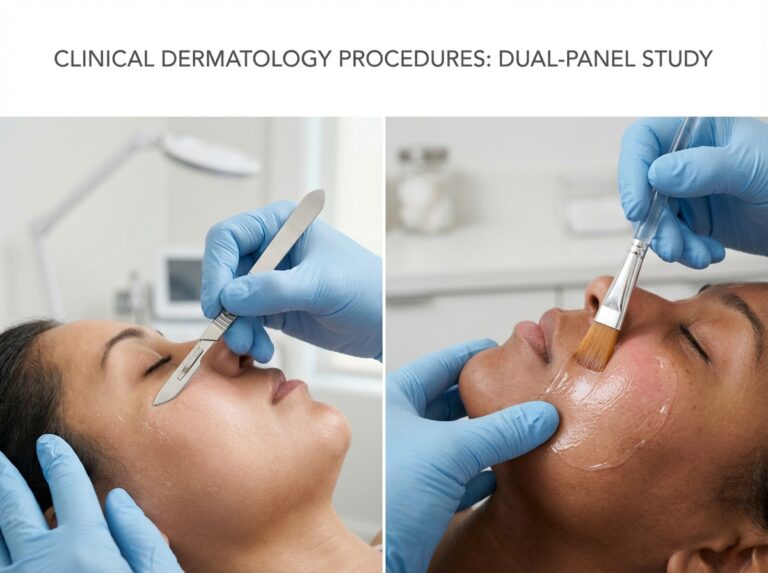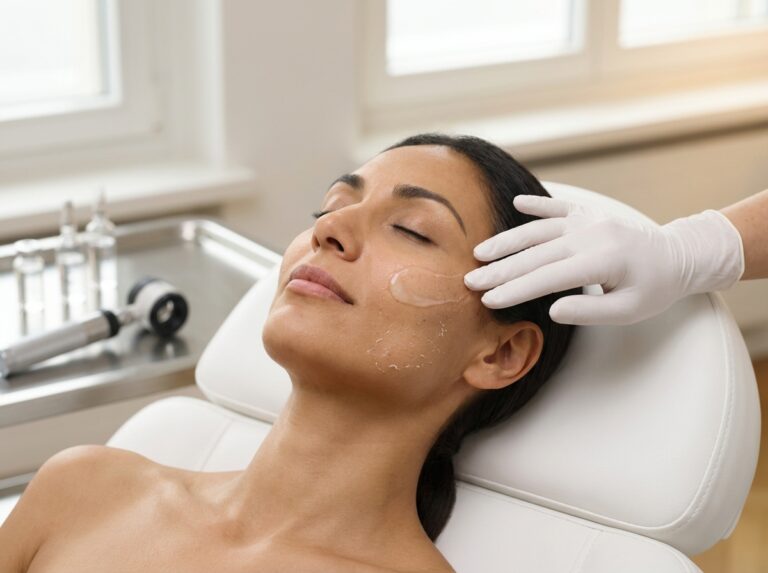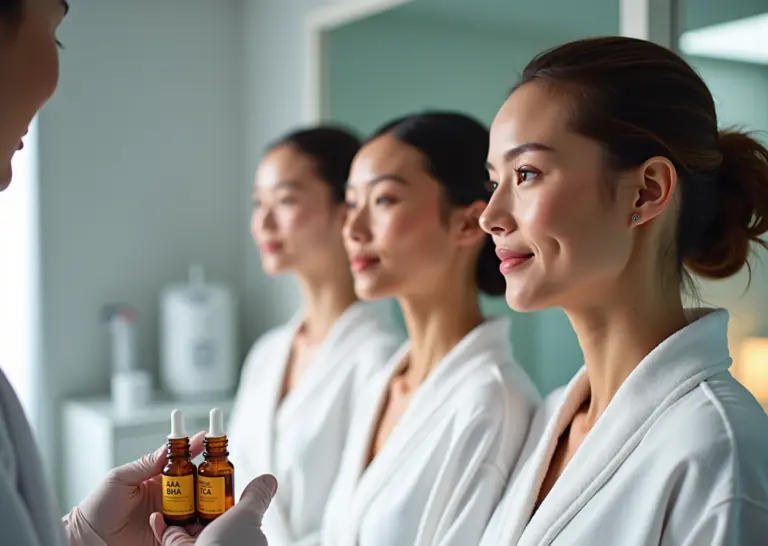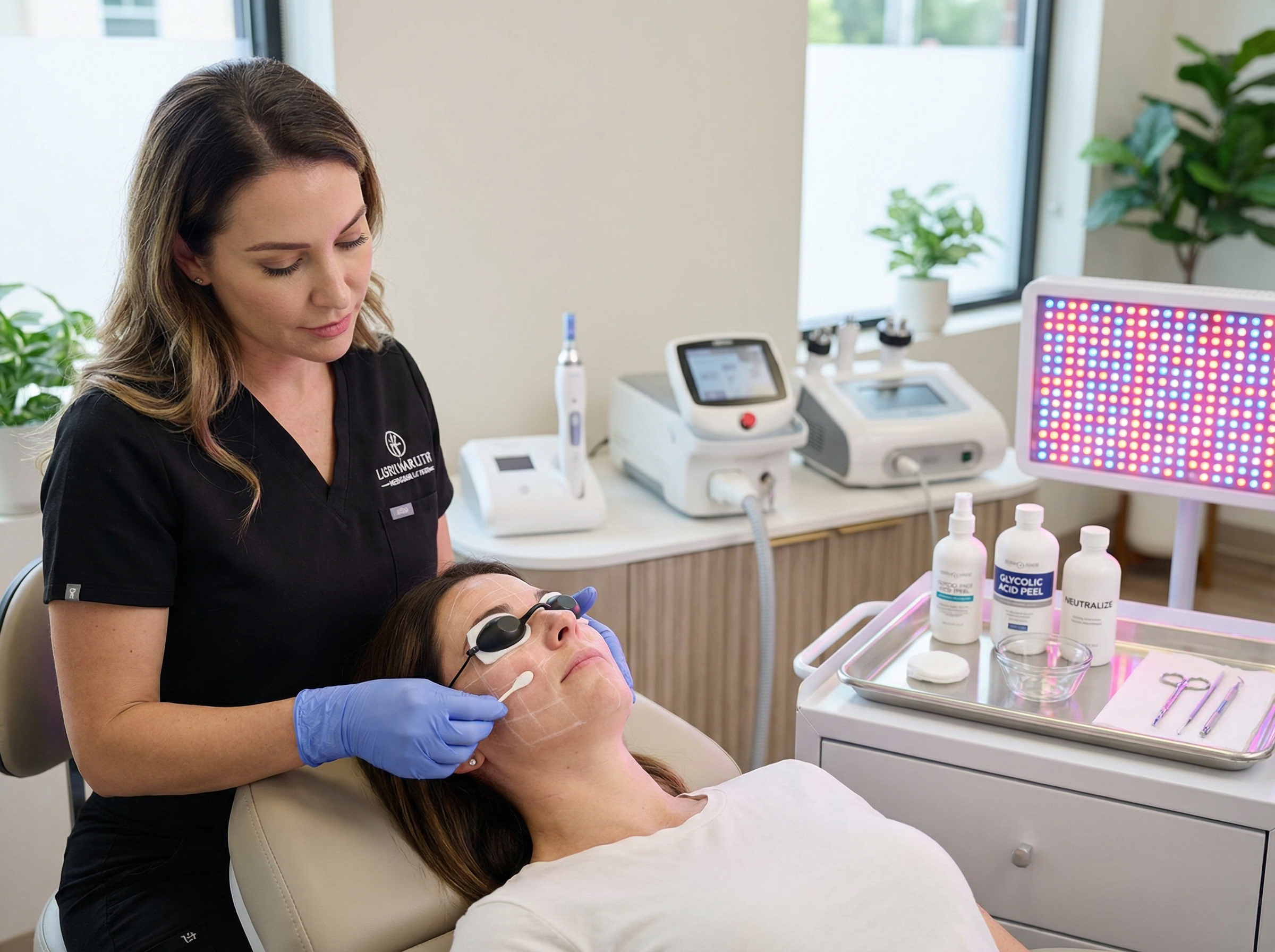
Glycolic acid peels are a cornerstone of non-invasive skin rejuvenation, prized for improving texture, brightening tone, and treating fine lines and hyperpigmentation. This article explains how glycolic peels work, how they compare to microneedling, lasers, RF, and LED, plus practical protocols and safety guidelines for U.S. practitioners and consumers.
Glycolic Acid Peels and How They Work
Glycolic acid remains the gold standard in alpha hydroxy acid (AHA) therapies because of its molecular size. It is the smallest AHA molecule. This small size allows it to penetrate the stratum corneum faster and deeper than lactic or mandelic acid. The primary mechanism involves the dissolution of desmosomes, the protein bridges that hold dead skin cells together. When glycolic acid disrupts these bonds, it triggers desquamation. The skin sheds the dull, outer layer of keratinocytes, revealing smoother skin underneath that reflects light more evenly.
There is a secondary mechanism that occurs below the surface. Glycolic acid stimulates fibroblasts in the dermis, increasing the synthesis of collagen and glycosaminoglycans like hyaluronic acid. The result is improved skin thickness and hydration over time. Recent dermatologic guidance from 2025 emphasizes that this dermal remodeling is dose-dependent. Higher concentrations produce more significant collagen stimulation but come with increased irritation risks.
The Critical Role of pH and Concentration
You cannot judge a peel by percentage alone. The efficacy of glycolic acid depends heavily on the pH level of the solution. The pKa of glycolic acid is 3.83. When the pH of the peel formulation matches the pKa, the solution contains 50% free acid and 50% salt. Only the free acid is biologically active.
In a U.S. medspa setting, professional peels typically range from 30% to 70% concentration, with a pH usually sitting between 0.6 and 2.5. A 30% peel at a pH of 2.0 is significantly stronger than a 30% peel at a pH of 3.0. The lower pH means more free acid is available to penetrate the skin.
Clinicians must understand neutralization. Unlike salicylic acid or TCA, which are often self-neutralizing, glycolic acid requires external neutralization. Water or a bicarbonate solution stops the acid activity. Leaving a low-pH glycolic peel on the skin for too long can cause epidermolysis or blistering. This is why timing is the most critical variable during the procedure.
Superficial vs. Medium Depth Peels
We categorize these treatments based on how deep the acid penetrates.
Superficial Peels (Lunchtime Peels)
These usually use 20% to 50% glycolic acid with a pH around 2.5 to 3.0. They target the stratum corneum and the upper epidermis. The goal is to brighten skin tone and smooth rough texture. Patients experience mild tingling and little to no visible peeling. These are ideal for maintenance and an immediate glow before events.
Medium-Depth Peels
These formulations often use 70% glycolic acid or combine glycolic acid with trichloroacetic acid (TCA). They penetrate to the papillary dermis. This level of injury is necessary to treat deeper acne scars, significant photodamage, and static wrinkles. The downtime is longer; patients will see visible flaking or sheeting of the skin for several days.
Formulations and Layering
Pure glycolic acid is intense. Many modern formulations blend it to mitigate irritation while maintaining efficacy.
- Buffered Peels: These have an adjusted pH to make the acid less aggressive. They are safer for sensitive skin but may require longer contact time to achieve results.
- Blended Peels: Combining glycolic with salicylic acid helps treat acne-prone skin by addressing both oil and texture. Blends with lactic acid increase hydration.
- Sequential Layering: Advanced protocols involve applying a layer of salicylic acid first to remove surface oil, followed by a layer of glycolic acid. This allows the glycolic acid to penetrate more evenly.
- Jessner’s Solution: This is a classic combination of resorcinol, lactic acid, and salicylic acid. Adding a layer of glycolic acid over a Jessner’s peel deepens the penetration for stubborn pigment.
Timeline for Results
Patients often expect miracles overnight. Managing these expectations is vital.
Immediate (1-3 Days): The skin looks brighter and feels smoother to the touch due to the removal of the rough, dead cell layer.
Short Term (1-4 Weeks): Pigmentation starts to fade. Post-inflammatory hyperpigmentation (PIH) from acne becomes lighter. The skin reflects light more evenly.
Long Term (3-6 Months): This is when collagen stimulation becomes visible. Fine lines soften, and the skin feels firmer. This requires a series of treatments, typically 4 to 6 sessions spaced 2 to 4 weeks apart.
Comparing Modalities for Texture and Tone
Chemical peels for texture are not the only option. We must compare them with other non-invasive skin rejuvenation tools to choose the right treatment.
| Modality | Primary Mechanism | Best For | Downtime | Limitations |
|---|---|---|---|---|
| Glycolic Peel | Chemical exfoliation | Surface texture, active acne, dullness, melasma | 0-5 days | Risk of burns if not neutralized; less effective for deep scars |
| Microneedling | Physical collagen induction | Acne scars, deep texture issues, pore size | 2-4 days | Does not brighten tone immediately; risk of infection |
| Fractional Laser | Thermal injury | Severe sun damage, deep wrinkles | 5-10 days | Higher cost; higher risk of PIH in dark skin |
| RF Microneedling | Heat + Physical injury | Skin laxity, deep scars | 2-5 days | Painful; expensive; requires skilled operator |
| LED Therapy | Photobiomodulation | Inflammation, mild maintenance | None | Results are subtle and slow; requires many sessions |
Glycolic acid peels excel at treating active acne and superficial pigment where lasers might be too risky or expensive. They are also superior for patients who cannot tolerate the heat of RF or lasers. However, for deep ice-pick scars, microneedling remains the better choice.
Clinical Evidence and Safety Profile
Clinical data through 2025 supports the safety of glycolic acid when used correctly. A recent systematic review highlighted that serial glycolic peels offer comparable efficacy to low-fluence laser toning for melasma but with lower rebound rates. The key outcome metric in these studies is the reduction in skin roughness and the Melasma Area and Severity Index (MASI) score.
Safety in the U.S. is regulated by FDA guidelines regarding labeling and sun sensitivity. Products with high concentrations are professional-use only. The Chemical Peel Market Size & Share reports indicate a massive surge in demand for these treatments in 2025, driven by their safety profile compared to more invasive options.
Adverse events usually stem from poor patient selection or incorrect neutralization. Darker skin types (Fitzpatrick IV-VI) require caution. Glycolic acid can cause hotspots, which can lead to PIH if the acid penetrates unevenly. Priming the skin with tyrosinase inhibitors before the peel series significantly reduces this risk.
Practical Protocols, Pre and Post Care, and Safety Tips
Patient Assessment and Selection Criteria
Successful outcomes start with choosing the right candidate. Not everyone suits a glycolic acid peel. The initial consultation determines safety and sets realistic expectations for texture improvement. Clinicians must evaluate skin type and history before applying any acid.
Fitzpatrick Skin Type Considerations
- Types I-III generally tolerate glycolic acid well. They have a lower risk of post-inflammatory hyperpigmentation (PIH).
- Types IV-VI require caution. Glycolic acid has a small molecular size and penetrates fast. This can trigger inflammation and pigment response in darker skin. Lower concentrations or buffered solutions are safer here. Verify that the provider has specific experience treating multicultural skin before proceeding.
Condition-Specific Selection
- Active Acne responds well to glycolic acid due to its keratolytic properties. It unblocks pores.
- Photodamage is the primary indication for texture issues. Look for rough patches and dullness.
- Melasma is tricky. Glycolic acid can help or hurt. Heat and inflammation worsen melasma. Aggressive peels are risky; low-dose maintenance is better. If pigment darkens after the first session, switch to a non-inflammatory enzyme treatment.
Contraindications and Medication History
Safety checks are non-negotiable. Review these factors during the intake.
- Isotretinoin (Accutane) requires a washout period. Most guidelines suggest waiting 6 to 12 months after stopping the drug before performing medium-depth peels.
- Photosensitizing drugs like tetracyclines or thiazides increase burn risk.
- Pregnancy and lactation are standard contraindications. While glycolic acid is arguably safer than salicylic acid in these cases, hormonal changes can make skin unpredictable and prone to melasma. Most clinics avoid chemical peels entirely to limit liability; always get written clearance from an obstetrician.
- Active infection such as Herpes Simplex requires prophylactic antivirals if the patient has a history of cold sores.
- Open wounds or recent facial surgery are absolute barriers to treatment.
Protocols for Concentration and Exposure
Customization prevents complications. A cookie-cutter approach causes burns. The concentration and pH determine the strength. Lower pH means higher potency. Here are standard protocols used in US medical spas in 2025.
| Indication | Skin Type | Concentration & pH | Application Time | Goal |
|---|---|---|---|---|
| Maintenance / Glow | Fitz I-VI | 20-30% (pH 2.0-3.0) | 1-3 minutes | Exfoliation, brightness |
| Texture / Fine Lines | Fitz I-III | 50-70% (pH 0.5-2.0) | 2-5 minutes | Collagen stimulation |
| Pigmentation / PIH Risk | Fitz IV-VI | 20-35% (Buffered) | 1-3 minutes | Tone correction without inflammation |
Pre-Treatment Preparation
Preparing the skin ensures even penetration and faster healing. This phase is often called priming.
The Priming Protocol
- Retinoid Washout: Stop Retin-A, retinol, or adapalene 5 to 7 days before the peel. These products thin the outer layer of the skin, increasing the risk of burns and scabbing.
- Acid Washout: Pause home-use AHAs or BHAs 3 to 5 days prior.
- Pigment Suppression: Vital for Fitzpatrick IV-VI. Prescribe a tyrosinase inhibitor like hydroquinone (4%) or non-hydroquinone alternatives (kojic acid, tranexamic acid) for 2 to 4 weeks pre-peel to reduce melanocyte activity.
- Patch Testing: Recommended for new patients or sensitive skin. Apply a small amount behind the ear or on the neck and wait 24 hours to check for allergic reactions.
In-Office Procedure Essentials
Consistency in application technique reduces error. Follow these steps for a safe treatment.
- Skin Prep: Begin with a gentle cleanser to remove makeup and debris.
- Degreasing: This is the most critical step for even penetration. Use acetone or an alcohol-based toner. Wipe until the skin is dry and free of oils. Uneven degreasing leads to “hot spots.”
- Protection: Apply petrolatum to sensitive areas, covering the corners of the eyes, nose, and lips.
- Application Technique: Use a fan brush or gauze. Gauze provides more friction and deeper penetration. Apply rapidly to ensure even timing, starting at the forehead and moving down.
- Monitoring: Watch the skin closely for erythema (redness). Glycolic acid usually does not produce true frost (coagulation of protein) like TCA. If frosting occurs, it may indicate epidermolysis or a burn; neutralize immediately.
- Pain Control: Patients will feel stinging, prickling, or an intense itch—often described as “spicy.” A scale of 1 to 10 helps monitor comfort. Neutralize if pain exceeds a 6 or 7. A handheld fan significantly reduces discomfort. Avoid numbing cream, as it alters acid penetration and masks feedback on hotspots.
- Neutralization: Mandatory for most glycolic peels. Use a sodium bicarbonate solution or water to stop the acid. Listen for the “fizzing” sound which indicates active acid neutralization.
Downtime and Post-Peel Management
Patients need to know what happens next. Managing expectations prevents panic calls.
Expected Effects
- Immediate: Skin looks pink or red and feels tight.
- Days 1 to 3: Dryness occurs. Skin may darken slightly as dead cells accumulate.
- Days 3 to 5: Flaking or peeling may occur. Superficial peels might only cause microscopic shedding (invisible peeling). Do not judge the success of the treatment by the amount of visible peeling. Social downtime is minimal; makeup can usually be worn the next day, but gyms and saunas should be avoided for 24 hours to prevent blistering from sweat.
Complication Management
- Prolonged Erythema: Redness lasting more than 24 hours requires topical corticosteroids.
- Post-Inflammatory Hyperpigmentation (PIH): Appears as dark spots. Treat with strict sun avoidance and reintroduce tyrosinase inhibitors once healing is complete.
- Infection: Rare but serious. Look for yellow crusting, pustules, or throbbing pain. Escalate to a dermatologist for antibiotics if suspected.
- Burns: Appear as gray or white sheets. Keep the area moist with an occlusive balm. Do not peel the skin.
Aftercare Recommendations
The skin barrier is compromised after a peel. The goal is protection and hydration.
- Cleansing: Use cool water and a non-foaming, gentle cleanser.
- Moisturizing: Use barrier repair creams containing ceramides or hyaluronic acid frequently.
- Sun Protection: The most important rule. Use a mineral SPF 30-50. Chemical filters might sting sensitized skin.
- Active Ingredients: Avoid retinoids, Vitamin C, or exfoliating acids for 5 to 7 days or until all flaking resolves.
- Maintenance: Schedule a “maintenance peel” every season (4 times a year) to sustain texture improvements.
Safe Combination Strategies
Medspas often stack treatments for better results. Timing is everything to avoid injury.
Sequencing and Intervals
- LED Therapy: Safe immediately after a glycolic peel. Red light reduces inflammation and speeds healing.
- Microneedling: Should generally be separated from peels. Wait 2 weeks between a medium-depth peel and microneedling. A “peel-then-needle” approach (peel first, needle 2 weeks later) clears the canvas for better results. Doing them too close together compromises the skin barrier.
- Laser Facials: Non-ablative lasers usually require a 2 to 4 week gap. Performing both in one session is aggressive and reserved for experienced providers.
- Radiofrequency (RF): Generates heat. Combine with caution. Usually, wait 1 to 2 weeks post-peel to perform RF.
At-Home vs. Professional Peels
Patients often ask if they can just buy products online. The difference lies in pH and concentration.
- At-Home Peels: Buffered with a higher pH (3.5 or above) and lower concentration (usually under 10-15%). They are safe for daily or weekly use but offer slow, cumulative results. Think of home products as daily maintenance like brushing your teeth.
- Professional Peels: Unbuffered or partially buffered, reaching the papillary dermis. They carry higher risks but correct texture issues that home products cannot touch. Think of these as the deep cleaning at the dentist.
Cost, Documentation, and Safety Checklist
The business side of peels requires transparency and rigorous record-keeping.
Estimated Costs
The Glycolic Acid Peel Market continues to grow as demand for non-invasive options rises. In 2025, the average cost for a professional glycolic peel in the U.S. ranges from $150 to $400 per session. Packages of 3 to 6 treatments often reduce the per-session price. Insurance typically does not cover these cosmetic procedures.
Documentation Essentials
- Informed Consent: Must cover risks of burns, scarring, and pigment changes.
- Photos: Take high-resolution images before every session to track progress and defend against liability claims.
- Chart Notes: Record the specific agent used, time on skin, patient reaction, and neutralization method.
Clinic Safety Checklist
- Neutralizing agent is within arm’s reach before starting.
- Eye wash station is accessible.
- Patient history is reviewed for recent sun exposure.
- Fan is available for patient comfort.
- Emergency contact for a supervising physician is posted.
Advanced Clinical Decision Making
We have reached a point in aesthetic medicine where options can feel overwhelming. Yet the data shows us that classic modalities remain relevant. The glycolic acid market is valued at over $522 million in 2025, proving that clinicians continue to rely on it for predictable results without the high overhead of energy-based devices.
The goal is to know exactly where a peel fits in a treatment plan. Use the following framework to guide your clinical decision making.
Decision Matrix: Peels vs. Energy Devices
Choosing between a chemical peel and a device is the first hurdle. You must assess the primary defect. Glycolic acid is an epidermal agent; it excels at surface-level refinement but is not the correct tool for structural changes.
| Indication | Primary Choice | Rationale |
|---|---|---|
| Rough Surface Texture | Glycolic Peel (30-50%) | Dissolves desmosomes efficiently. Immediate tactile improvement. |
| Deep Acne Scarring | Microneedling | Physical remodeling of collagen is required. Peels are too superficial. |
| Static Deep Wrinkles | CO2 or Erbium Laser | Requires significant thermal injury to stimulate deep contraction. |
| Mild Hyperpigmentation | Glycolic Peel Series | Exfoliates pigment-laden keratinocytes without high heat risks. |
| Vascular Issues (Redness) | IPL or PDL Laser | Glycolic acid does not target hemoglobin. |
If a patient presents with both texture issues and deep laxity, you cannot rely on peels alone. You will need a combination approach. However, for the specific complaint of dullness and uneven epidermal tone, the glycolic peel often offers a better return on investment and lower downtime than a laser resurfacing treatment.
Protocol Templates for Medspas
Standardization ensures safety. You should have two distinct tracks for glycolic treatments.
Corrective Series Protocol
This is for the patient with visible photodamage or acne congestion.
- Frequency: One treatment every 2 to 3 weeks.
- Duration: A series of 4 to 6 treatments.
- Progression: Start with 20% or 30% for 3 minutes. Increase time first, then concentration. Do not jump from 30% to 70% in the second session.
- Goal: Cumulative exfoliation to shift stubborn pigment and smooth texture.
Maintenance Protocol
This is for the patient who has achieved their goals and wants to sustain them.
- Frequency: One treatment every 6 to 8 weeks.
- Timing: Can be alternated with facials or other mild modalities.
- Concentration: Stick to a “safe zone” of 30% to 40%. There is rarely a need to go higher for maintenance.
- Goal: Cellular turnover regulation and glow.
Actionable Plan for Implementation
You can integrate these practices immediately. Start by auditing your intake forms. Ensure they ask about specific acids and retinoids. Next, check your back bar. Do you have a range of concentrations (20%, 30%, 50%), or just one bottle? You need variety to customize the treatment.
Train your staff on the “endpoint.” They should be looking for erythema (pinkness), not pain tolerance. If the skin turns bright pink, the treatment is done, regardless of what the timer says. Finally, focus on the post-care kit. Do not let a patient leave without a physical sunscreen and a bland moisturizer. The success of the peel depends on how they treat their skin in the 48 hours following the appointment.
Glycolic Acid Market | Global Market Analysis Report – 2035 indicates that the demand for these treatments will only grow as the population seeks effective anti-aging solutions. By adhering to strict safety protocols and managing patient expectations, you can make glycolic peels a high-satisfaction pillar of your practice.
References
- United State Glycolic Acid Market 2025: Industry Developments, — The glycolic acid market was valued at USD 309.3 million in 2021, and it is set to reach USD 604.4 million by 2030, growing at a CAGR of 7.7% …
- Glycolic Acid Peel Charting Growth Trajectories 2025-2033 — Discover the booming glycolic acid market! Our comprehensive analysis reveals a $457 million market in 2025, projected to grow at a 6.4% CAGR.
- Glycolic Acid Market | Global Market Analysis Report – 2035 — The glycolic acid market is valued at USD 522.4 million in 2025 and is projected to reach USD 819.1 million by 2035, growing at a CAGR of 4.6%.
- Glycolic Acid Market Size, Share, and Growth Forecast 2025 – 2032 — The global glycolic acid market size is expected to be valued at US$425.0 million in 2025 and is projected to reach US$691.4 million by 2032, …
- Chemical Peel Market Size & Share | Industry Report, 2030 — Market size value in 2025. USD 2.2 billion ; Revenue forecast in 2030. USD 2.8 billion ; Growth rate. CAGR of 5.6% from 2025 to 2030 ; Base year for estimation.
- Glycolic Acid Peel Market Size, Growth, Share Analysis, 2035 — The Glycolic Acid Peel Market is projected to grow at 4.56% CAGR from 2025 to 2035, driven by increasing demand for skin rejuvenation and anti-aging treatments.
- Glycolic Acid Peel 2025 to Grow at XX CAGR with XXX million … — The size of the Glycolic Acid Peel market was valued at USD XXX million in 2024 and is projected to reach USD XXX million by 2033, …
- Glycolic Acid Market Size, Share, Growth & Analysis, 2033 — The glycolic acid market size was valued at USD 622.22 million in 2024 and is anticipated to reach USD 668.02 million in 2025 and USD 1179.03 …
- Analyzing Glycolic Acid Peel: Opportunities and Growth Patterns … — The North American market holds a significant share (approximately 40%) of the global glycolic acid peel market, driven by high disposable …
- Chemical Peeling Market Size & Share 2025-2032 – 360iResearch — The Chemical Peeling Market size was estimated at USD 1.28 billion in 2024 and expected to reach USD 1.46 billion in 2025 …
Legal Disclaimers & Brand Notices
The content provided in this article is for informational purposes only and does not constitute professional medical advice, diagnosis, or treatment. Always seek the advice of a qualified physician or other licensed healthcare provider with any questions you may have regarding a medical condition or specific aesthetic procedure. Never disregard professional medical advice or delay in seeking it because of something you have read in this article.
All product names, logos, and brands mentioned within this text are the property of their respective owners. All company, product, and service names used in this article are for identification purposes only. Use of these names, logos, and brands does not imply endorsement, affiliation, or certification by the trademark owners.