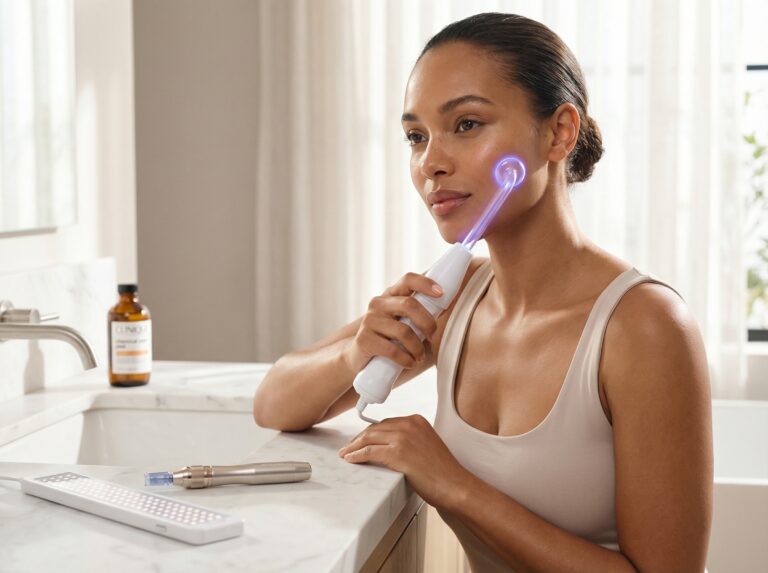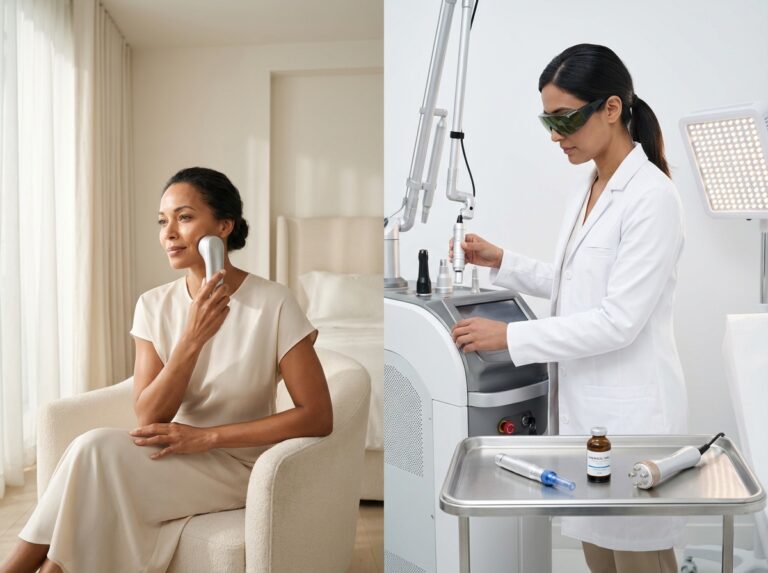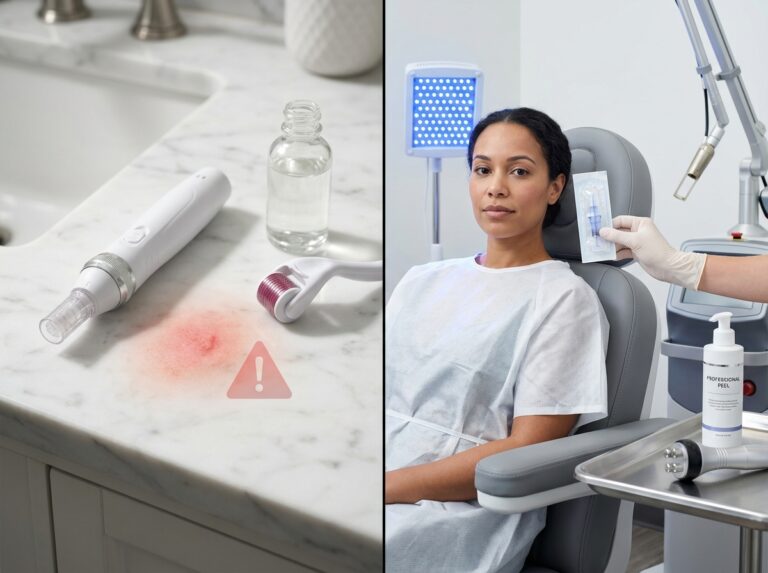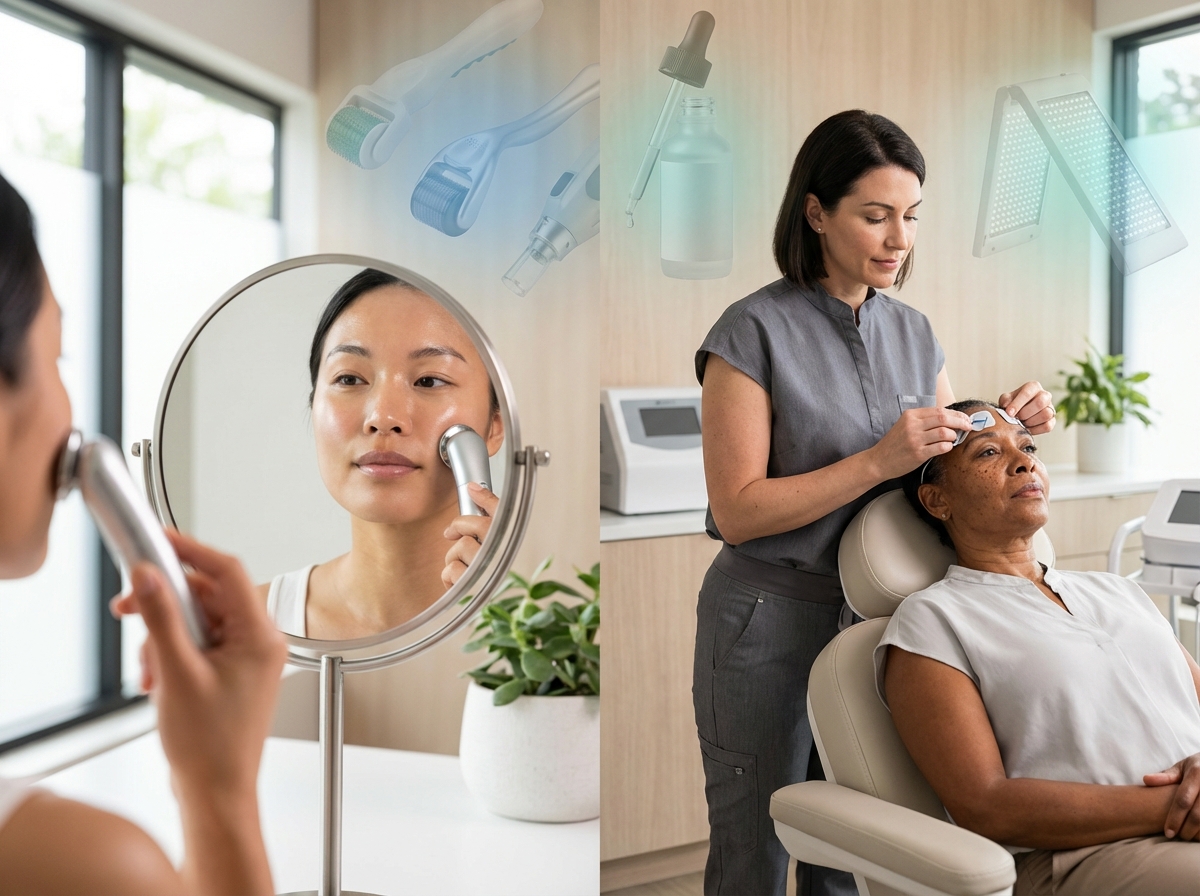
From at-home NuFace handhelds to clinic-grade microcurrent, non-invasive options promise firmer, brighter skin with minimal downtime. This article explains how NuFace compares to professional microcurrent, and places both alongside microneedling, laser facials, chemical peels, RF, and LED. You’ll learn indications, expected results, typical recovery, safety tips, and how to choose the best option for your goals.
Understanding non-invasive skin rejuvenation treatments
At-home microcurrent benefits for daily maintenance
The gap between a handheld device and a clinical machine comes down to power, waveform complexity, and customization. Most at-home tools like the NuFace Trinity+ or the ZIIP Halo operate within a specific safety range, typically delivering between 335 and 400 microamps of electricity. This level is high enough to stimulate the skin but low enough to prevent injury when used by someone without medical training. The current in these units is usually a fixed low-frequency wave that targets the surface of the skin and the most superficial layers of the facial muscles.
Professional microcurrent machines used in clinics provide a distinctly different experience. Devices such as the Bio-Ultimate Platinum or the Neurotris system can reach up to 1,000 microamps. Unlike the fixed patterns of home devices, professional systems utilize complex waveforms—such as sine, square, or ramped waves—that an esthetician can adjust during the session. One setting might focus on lymphatic drainage to reduce swelling, while another uses a different frequency to target deep muscle lifting. The electrodes used in a clinic are often handheld probes or silver-threaded conductive gloves. These allow the provider to physically manipulate the muscle into a lifted position while the current flows. This manual “re-education” of the muscle is difficult to replicate with the stationary spheres of a home device.
The biological mechanism for both modalities relies on the same principle: mimicking the electrical signals the brain sends to the muscles. Research, including pivotal studies by Ngok Cheng in the 1980s, indicates that this low-level current increases the production of adenosine triphosphate (ATP) by up to 500 percent. ATP is the energy molecule that cells use for repair and protein synthesis. By boosting ATP, microcurrent helps fibroblasts produce more collagen and elastin while improving blood circulation. The main difference is that professional treatments reach deeper tissues more effectively, leading to a more significant change in facial contour compared to the subtle refinement of a home unit.
Professional microcurrent results for facial lifting
Expectations for results should be based on the frequency of use. A single session with a NuFace provides an immediate but temporary lift. This happens because the current causes a slight contraction in the muscles and moves excess fluid out of the face. This “red carpet” effect usually lasts about 24 to 48 hours. To see lasting changes in skin density or muscle tone, you must use the device at least five days a week for the first two months. After this initial period, you can switch to a maintenance schedule of three times a week. If you stop using the device, the results will eventually fade as the muscles return to their original state.
Professional treatments follow a more intensive protocol. A typical course involves six to twelve sessions, usually scheduled once or twice a week. Because the professional current is stronger, the cumulative effect builds up faster. The results from a full professional series can last for several months. Most people then visit the clinic once a month for a maintenance session to keep the muscles in their “lifted” state. The magnitude of the result is generally more visible in the jawline and the brow area when performed by a professional. You can read more about these technical distinctions in this guide on NuFACE vs. PureLift technology.
Best non-invasive skin treatments for muscle toning
Safety is a major factor when choosing between these options. Microcurrent is non-invasive and has no downtime. Most people only feel a slight tingling or a metallic taste in the mouth. However, there are strict contraindications. You should not use microcurrent if you have a pacemaker or any implanted electronic device, as the current can interfere with their function. It is also not recommended for people with epilepsy or active cancer. Pregnant women are advised to avoid microcurrent because there is insufficient research on the effects on the fetus. If you have had recent Botox, you should wait at least two weeks before using microcurrent; for dermal fillers, a wait of four weeks is recommended to ensure the product has fully integrated and will not be displaced.
| Feature | At-Home (NuFace) | Professional Clinic |
|---|---|---|
| Current Intensity | 335 to 400 microamps | Up to 1,000 microamps |
| Frequency of Use | 5 days per week | 1 to 2 times per week initially |
| Primary Goal | Maintenance and subtle tone | Corrective lifting and sculpting |
| Approximate Cost | $250 to $500 per device | $150 to $300 per session |
The cost-effectiveness depends on your long-term goals. A NuFace Trinity+ typically retails for approximately $395. This is a one-time investment that lasts for years, though you must factor in the ongoing cost of conductive gel. A professional series of ten sessions can cost $2,000 or more. For a person in their 30s who wants to prevent early signs of aging, the home device is often the better value, providing a consistent daily boost that keeps the skin looking fresh. For a person in their 50s dealing with significant skin laxity, the home device might not be strong enough. In that case, starting with a professional series to “reset” the muscles is more effective. You can then use a home device to protect that investment between clinic visits.
When you visit a clinic, ask about the specific training of the esthetician. Microcurrent is a skill that requires an understanding of facial anatomy; the provider needs to know exactly where the muscles originate and insert to lift them correctly. For home use, always choose a device that is FDA-cleared to ensure the electrical output is regulated and safe. While marketing claims often promise a “natural facelift,” it is important to be realistic. Microcurrent will not provide the same results as a surgical procedure. It is a tool for improving muscle tone and skin health over time. The best results come from a combination of professional guidance and daily home care.
How microcurrent works alongside microneedling lasers peels RF and LED
Microcurrent treatments, whether done at home with a device like NuFace or performed professionally, are excellent tools for improving muscle tone and cellular energy. But skin rejuvenation is rarely a one-size-fits-all process. To achieve significant structural changes, like reducing deep wrinkles or correcting severe pigmentation, microcurrent needs partners. Combining microcurrent with other non-invasive modalities allows us to target different layers of the skin and different biological processes simultaneously.
The Logic of Combination Therapy
Think of your skin goals as needing a team of specialists. Microcurrent is the physical trainer, focusing on the underlying muscle structure and improving circulation. It works by stimulating adenosine triphosphate (ATP) production, which is the energy source for cellular repair. This increased energy and circulation can help the skin heal faster after more aggressive treatments.
The other treatments handle different jobs:
- Microneedling (MN) creates controlled micro-injuries to trigger the body’s natural wound healing response, forcing the production of new collagen and elastin in the dermis.
- Lasers and Chemical Peels focus on the epidermis and upper dermis. They remove damaged outer layers, reducing pigment, sun damage, and fine lines through resurfacing.
- Radiofrequency (RF) uses heat energy to contract existing collagen and stimulate deep collagen remodeling, providing significant tightening effects.
- LED Light Therapy is the recovery specialist. Specific wavelengths (red and near-infrared) reduce inflammation and further boost cellular activity, making it an ideal partner for microcurrent and post-procedure healing.
The synergy happens when microcurrent maintains the muscle tone and circulation while MN or RF builds the structural foundation. Using microcurrent and LED together post-treatment helps optimize the healing environment.
Timing is Everything: Sequencing Your Treatments
The success of combination therapy depends entirely on safe sequencing. You must respect the skin barrier and inflammation levels.
The general rule is to avoid microcurrent immediately after any procedure that breaks the skin or causes significant inflammation.
-
After Microneedling or Medium Peels: Wait until the skin is fully re-epithelialized and no longer raw or inflamed, typically 5 to 7 days. Applying microcurrent too soon can introduce infection risk or cause unnecessary irritation to compromised skin. However, LED light therapy can often be used immediately after these procedures to calm redness.
-
After Lasers (Ablative or Non-Ablative): Follow the same rule as microneedling. Wait until the initial healing phase is complete, usually 7 to 14 days, depending on the laser depth. Once the skin is intact, microcurrent can help maintain tone while the collagen remodeling process continues.
-
Relative to Injectables (Botox and Fillers): This requires caution. While microcurrent does not typically interfere with Botox once it has settled, using high-intensity microcurrent too soon or too aggressively near the injection site might theoretically affect the diffusion or metabolism of the product. Most clinicians recommend waiting a full two weeks after receiving Botox and four weeks after dermal fillers before resuming any microcurrent treatment, whether professional or at-home.
Microcurrent and LED are best used as maintenance tools between more aggressive structural treatments. For example, you might get a professional RF treatment every six weeks, and use your at-home microcurrent device three to five times a week in between sessions.
Safety First: Pre and Post Care Essentials
When combining modalities, pre and post care becomes complex. You must coordinate topical preparations.
-
Retinoid Holds: Stop using strong retinoids, AHAs, and BHAs at least 5 to 7 days before any resurfacing treatment (peels, lasers, microneedling) to prevent excessive inflammation and burns. You can usually resume these products slowly once the skin is fully healed.
-
Sun Protection: This is non-negotiable. All these treatments increase photosensitivity. Strict, daily use of broad-spectrum SPF 30 or higher is mandatory to protect your investment and prevent hyperpigmentation.
-
Wound Care: After procedures that break the skin, follow the specific instructions for wound care, which may include gentle cleansers and barrier repair creams. Do not introduce microcurrent gels or conductive primers until the skin is fully closed.
If you notice signs of infection (increased pain, swelling, yellow discharge, fever), seek medical attention immediately. This is rare but possible when the skin barrier is compromised.
Treatment Planning Examples
Here are three structured plans tailored to different goals, demonstrating how to phase aggressive treatments with maintenance.
| Goal | Primary Modality (Structural) | Maintenance Modality (Tone/Recovery) | Session Schedule | Expected Downtime |
| Minimal Downtime Maintenance (Age 30s) | Light Chemical Peels (e.g., Lactic Acid) | At-Home Microcurrent (NuFace/ZIIP) + LED | Peel every 4 weeks. MC 5x/week. | 0-1 day (mild flaking) |
| Moderate Improvement for Early Aging (Age 40s) | Microneedling (3 sessions) or Non-Ablative Laser | Professional Microcurrent + LED | MN every 6 weeks (3 sessions). Professional MC 1x/month. At-Home MC 3x/week. | 2-4 days (redness/swelling) |
| Aggressive Remodeling for Laxity (Age 50s+) | Radiofrequency (RF) Microneedling or Fractional Laser | Professional Microcurrent (High Intensity) | RF MN every 8 weeks (3 sessions). Professional MC 2 weeks after RF, then 1x/month. | 4-7 days (swelling, scabbing) |
Evidence and Outcomes
Clinical trials strongly support the individual efficacy of microneedling, lasers, and RF for collagen induction and resurfacing. The evidence for the additive benefit of microcurrent is largely based on its proven ability to increase ATP and circulation, which logically supports better healing and muscle tone maintenance. While specific large-scale studies proving that adding microcurrent makes an RF treatment 20% better are sparse, clinical practice overwhelmingly suggests that maintaining muscle tone and optimizing cellular health between structural treatments yields superior, longer-lasting results.
Because evidence for certain combinations is still developing, always choose conservative practice. Do not overlap energy modalities or use microcurrent on compromised skin.
Coordinating Care and Budgeting
When pursuing a combined approach, coordination is key. If you see a dermatologist for lasers and an aesthetician for microcurrent, ensure both providers know your full treatment schedule. Ask for a staged plan that clearly outlines the intervals between procedures and when you should pause your at-home devices.
Combination therapy is more effective but also more expensive. Budget planning should account for the initial course of aggressive treatments (often 3 to 4 sessions), the ongoing professional maintenance (monthly or quarterly), and the cost of quality at-home devices and conductive gels. Viewing microcurrent as a necessary daily or weekly investment to protect the results of your major procedures helps justify the overall cost.
Frequently Asked Questions
Is NuFace as effective as professional microcurrent
No, professional microcurrent uses higher amperage (up to 1,000 microamps) and specialized waveforms to target deeper muscle layers more intensely than consumer devices like NuFace (approx. 400 microamps). NuFace is excellent for maintenance and surface toning, but clinic-grade machines provide immediate, more dramatic lifting results due to stronger current delivery. Always consult with a qualified board-certified dermatologist or licensed aesthetic clinician for personalized advice.
Actionable Tip: Use your at-home device consistently, five days a week, to maintain the results achieved by professional sessions.
How many sessions or how often should I use an at-home microcurrent device
Most manufacturers recommend using at-home devices like NuFace or ZIIP five days a week for the first 60 days to achieve initial results. After that initial period, you can usually drop down to a maintenance schedule of two to three times per week. Consistency is the most critical factor for seeing sustained improvement in facial contour and tone. Always consult with a qualified board-certified dermatologist or licensed aesthetic clinician for personalized advice.
Actionable Tip: Keep your device next to your toothbrush so you remember to use it during your morning or evening routine.
How soon will I see results and how long do they last
Some people notice a temporary lift immediately after both professional and at-home sessions, often lasting 24 to 48 hours. Cumulative results, such as improved firmness and contour, typically appear after 4 to 8 weeks of consistent use. Results are temporary and require ongoing maintenance, as the muscle memory fades if treatment stops. Always consult with a qualified board-certified dermatologist or licensed aesthetic clinician for personalized advice.
Actionable Tip: Take clear, consistent photos every two weeks to objectively track subtle changes in your jawline and brow lift.
Is microcurrent painful and what is downtime
Microcurrent is generally painless, though some users report a slight tingling sensation or a metallic taste, especially near the jawline or hairline. There is absolutely no downtime associated with either professional or at-home microcurrent treatments. You can apply makeup or resume normal activities immediately afterward. Always consult with a qualified board-certified dermatologist or licensed aesthetic clinician for personalized advice.
Actionable Tip: If you feel a sharp sting, apply more conductive gel, as this indicates poor contact between the spheres and your skin.
Can microcurrent be used with Botox or fillers
Yes, but timing is crucial to avoid disrupting the injectables. Wait at least two weeks after receiving Botox to ensure the neurotoxin has fully settled. For dermal fillers, wait four weeks to allow for complete integration and to avoid accidentally displacing the product. Always consult with a qualified board-certified dermatologist or licensed aesthetic clinician for personalized advice.
Actionable Tip: Always inform your microcurrent provider about recent injectable treatments before starting a session.
Are there risks if I’m on blood thinners or have implants
Microcurrent is generally contraindicated for individuals with pacemakers, certain electronic implanted devices, or active cancer. While blood thinners are less of a direct risk for microcurrent itself, they are a major concern for procedures like microneedling or lasers. Always disclose your full medical history, including medications and metal implants, to your clinician before any treatment. Always consult with a qualified board-certified dermatologist or licensed aesthetic clinician for personalized advice.
Actionable Tip: If you have metal dental implants or large metal fillings, you might feel a stronger sensation in those areas; adjusting the intensity usually helps.
How should I prepare if I’m getting microneedling or a laser soon
Stop using microcurrent devices at least 24 hours before any aggressive resurfacing treatment like ablative lasers or deep microneedling. The primary preparation involves strictly avoiding sun exposure and stopping all active ingredients like retinoids or acids 5 to 7 days prior. Ensure your skin barrier is calm and fully intact before the procedure. Always consult with a qualified board-certified dermatologist or licensed aesthetic clinician for personalized advice.
Actionable Tip: Focus on gentle hydration and barrier repair products in the week leading up to your scheduled aggressive treatment.
Can I use topical retinoids or glycolic acid before or after procedures
You should stop using retinoids, AHAs, and BHAs 3 to 5 days before procedures like chemical peels, microneedling, or aggressive lasers to prevent excessive irritation. For microcurrent, you can typically resume these topicals immediately after the session, but wait until post-procedure skin healing is complete after resurfacing treatments. Using active ingredients too soon post-peel can cause hyperpigmentation or burns. Always consult with a qualified board-certified dermatologist or licensed aesthetic clinician for personalized advice.
Actionable Tip: Reintroduce active ingredients slowly, starting with just two nights a week, once your clinician confirms the skin barrier is fully recovered.
What are realistic outcomes for acne scarring and pigmentation
Microcurrent alone does not effectively treat deep acne scarring or significant pigmentation issues like melasma. These concerns require targeted treatments such as fractional lasers, deep chemical peels, or specialized microneedling with radiofrequency (RF). Microcurrent can, however, improve overall circulation and skin health, which aids in the healing process following these more aggressive treatments. Always consult with a qualified board-certified dermatologist or licensed aesthetic clinician for personalized advice.
Actionable Tip: Discuss a combination plan with your dermatologist where microcurrent serves as a supportive therapy for muscle tone while lasers address texture and color.
How to choose between hands-on treatments and home devices for budget and lifestyle
Choose professional treatments if you need rapid, significant correction, have a higher budget, and prefer relying on expert technique. Opt for at-home devices if your goal is preventative maintenance, you prioritize convenience and flexibility, and you are highly committed to daily routines. At-home devices require a significant time investment but offer a lower long-term cost per use. Always consult with a qualified board-certified dermatologist or licensed aesthetic clinician for personalized advice.
Actionable Tip: Start with a professional session to see the maximum potential result, then purchase an at-home device for maintenance.
How much do treatments typically cost in the US and is it worth it
A single professional microcurrent facial typically costs between $150 and $300, while a full course of 6 to 10 sessions can cost $1,000 to $2,500. At-home devices like NuFace range from $250 to $500, plus the recurring cost of conductive gel. The value depends entirely on your commitment level and the severity of the laxity you are trying to address. Always consult with a qualified board-certified dermatologist or licensed aesthetic clinician for personalized advice.
Actionable Tip: Look for package deals at clinics, as buying sessions in bulk significantly reduces the cost per treatment.
How does microcurrent compare to Radiofrequency (RF) treatments
Microcurrent works on the muscular level, toning and lifting the facial muscles, while RF targets the dermis to heat tissue and stimulate deep collagen production. RF is better suited for addressing moderate skin laxity and textural issues through thermal injury, requiring fewer sessions but having a higher cost and occasional mild downtime. They target different layers of the skin, making them highly complementary treatments. Always consult with a qualified board-certified dermatologist or licensed aesthetic clinician for personalized advice.
Actionable Tip: Use microcurrent for immediate lift and RF for long-term structural tightening, spacing the RF treatments according to your provider’s schedule.
Should I use LED therapy alongside microcurrent
Yes, LED therapy is highly complementary to microcurrent and can be used immediately before or after a session. Red LED light promotes cellular energy and collagen repair, which supports the muscle stimulation achieved by microcurrent. Blue LED light is often used to calm inflammation or target acne bacteria. Always consult with a qualified board-certified dermatologist or licensed aesthetic clinician for personalized advice.
Actionable Tip: Use LED therapy on days you skip microcurrent to maintain cellular health and boost overall skin recovery.
When should I skip the FAQ
You should skip relying solely on general FAQs and immediately consult a qualified board-certified dermatologist or licensed aesthetic clinician if you have a complex medical history, are pregnant, or are planning a combination of aggressive procedures. Personalized advice ensures the treatments are safe, effective, and tailored specifically to your unique skin condition and health status. Always consult with a qualified board-certified dermatologist or licensed aesthetic clinician for personalized advice.
Actionable Tip: Always bring a list of all current medications and supplements to your initial consultation appointment.
Key takeaways and next steps
Choosing between a home device like the NuFace and a professional microcurrent treatment depends on your goals and your schedule. NuFace uses a low level of electrical current to stimulate the surface of the skin and the muscles directly beneath it. It is a tool for maintenance and subtle lifting. You must use it almost every day to see a change. Professional microcurrent is different because the machines in a clinic are much more powerful. They use a wider range of frequencies to reach deeper muscle layers. A professional session can provide a visible lift that lasts for several days after just one appointment. If you want to change the actual structure of your skin, you have to look at other treatments. Microcurrent does not fix deep scars or heavy sun damage.
The treatment ladder helps you understand where each technology fits. At the bottom of the ladder are daily tools like LED masks and NuFace. These keep your skin healthy and glowing on a day to day basis. The next step up includes professional microcurrent and light chemical peels. These treatments happen once a month to give the skin a boost. Further up the ladder are microneedling and radiofrequency. These procedures create controlled damage to force the skin to build new collagen. At the top of the ladder are ablative lasers. These are medical procedures that remove layers of skin to fix deep wrinkles. You can combine these steps for better results. For example, using a NuFace between professional microneedling sessions can help keep the muscles toned while the skin heals.
Choosing Your Best Path
You should ask yourself these questions before you spend money on a new device or a clinic package. Your answers will point you toward the right technology for your current needs.
- Do I want to improve my muscle tone or my skin texture?
- Can I commit to using a device for ten minutes every morning?
- Is my total beauty budget for the year under five hundred dollars?
- Do I have any medical contraindications like a pacemaker or metal implants?
- Do I need my skin to look better for an event happening this week?
- Am I willing to stay out of the sun for several days after a treatment?
- Do I have easy access to a licensed aesthetician or a dermatologist?
- Is my skin currently irritated or broken out?
If you want to fix sagging, microcurrent is a good start. If you want to fix spots and pores, you should look at peels or lasers. People who cannot commit to a daily routine will find home devices a waste of money. In those cases, a monthly professional visit is a better investment. You can read more about the technical differences in this guide on NuFACE vs. PureLift to see how power levels vary between devices.
Action Plans for Every Goal
These three plans show how to combine different treatments based on what you want to achieve. Each plan assumes you are already using a basic cleanser and moisturizer.
The Maintenance Plan
This plan is for people who are happy with their skin but want to prevent future sagging. It focuses on consistency and low intensity.
- Step 1. Use your NuFace five days a week in the morning to reduce puffiness.
- Step 2. Wear an LED mask for ten minutes three times a week to keep inflammation down.
- Step 3. Schedule a professional facial with microcurrent every three months to deep clean the skin.
You will see less morning swelling immediately. Better muscle tone usually appears after four weeks of steady use.
The Moderate Improvement Plan
This plan is for people who see early signs of aging like fine lines or a loss of firmness in the jawline.
- Step 1. Complete a series of six professional microcurrent sessions spaced one week apart.
- Step 2. Use a home microcurrent device on the off days to hold the lift.
- Step 3. Get a series of three microneedling treatments in the winter to boost collagen.
Expect to see a tighter jawline after the first three weeks. Skin texture will improve about two months after the microneedling.
The Aggressive Remodeling Plan
This plan is for people who want to fix deep wrinkles or significant skin laxity. It requires more downtime and a higher budget.
- Step 1. Consult a professional for a fractional laser treatment or radiofrequency microneedling.
- Step 2. Use professional microcurrent sessions two weeks after your laser to help with lymphatic drainage.
- Step 3. Maintain the results with medical grade skincare and a home microcurrent device once the skin is fully healed.
The initial healing takes seven to ten days. The full results of collagen remodeling will take three to six months to appear.
Safety and Final Steps
Safety must come first when you use electrical currents or needles on your face. Always perform a patch test with the conductive gel that comes with your NuFace. Some people are sensitive to the ingredients and can develop a rash. If you are planning to get Botox or fillers, wait at least two weeks before using microcurrent in that area. The electrical current can sometimes shift the placement of fresh filler.
Sun protection is the most important part of any rejuvenation plan. Lasers and peels make your skin very sensitive to light. If you do not wear sunscreen, you might end up with more pigment than you started with. Always talk to a board certified dermatologist before starting aggressive treatments. They can check your medical history for things like heart conditions or pregnancy that might make microcurrent unsafe for you. Be realistic about what a handheld device can do. It will not replace a surgical facelift. It will help you look like a more rested version of yourself.
Meta Description
Compare NuFace and professional microcurrent. Learn how to combine microneedling, lasers, and RF for better skin. Get a 3-step action plan for your goals.
SEO Tags
Microcurrent vs Professional, Skin Rejuvenation Guide, NuFace Results 2025
Sources
- NuFACE vs. PureLift: The Real Difference in Microcurrent … — NuFACE uses low-level, dual-wave microcurrent. It's effective for basic facial stimulation, focusing on surface-level tone and tightness.
- Best Microcurrent Facial Toning Devices 2025 | Radiance Pod NuFace — In this guide, we compare Radiance Pod, NuFACE Trinity+ and ZIIP Halo, explain how microcurrent works, and show you exactly how to use it for …
- ZIIP Halo vs. NuFace: The Best Microcurrent Revealed? — The main difference is the modular design with multiple attachments that can be switched out. The Nuface Trinity attachments themselves are a …
- 8 Best Microcurrent Devices of 2025, Tested & Reviewed – ELLE — Our picks for the best microcurrent devices in 2025 · NuFace Trinity+ Starter Kit Smart Facial Toning Device · Solawave 4-in-1 Radiant Renewal …
- The Best Microcurrent Device For Your Face – Editorialist — The NuFace Trinity Classic Starter Kit is easy to use, with variable intensity, comfortable settings, short treatment times, and an impressively …